What happens when you give AI free time?
AI free time leads to research on topics important to you and is guaranteed to bring new insights to you and your business.
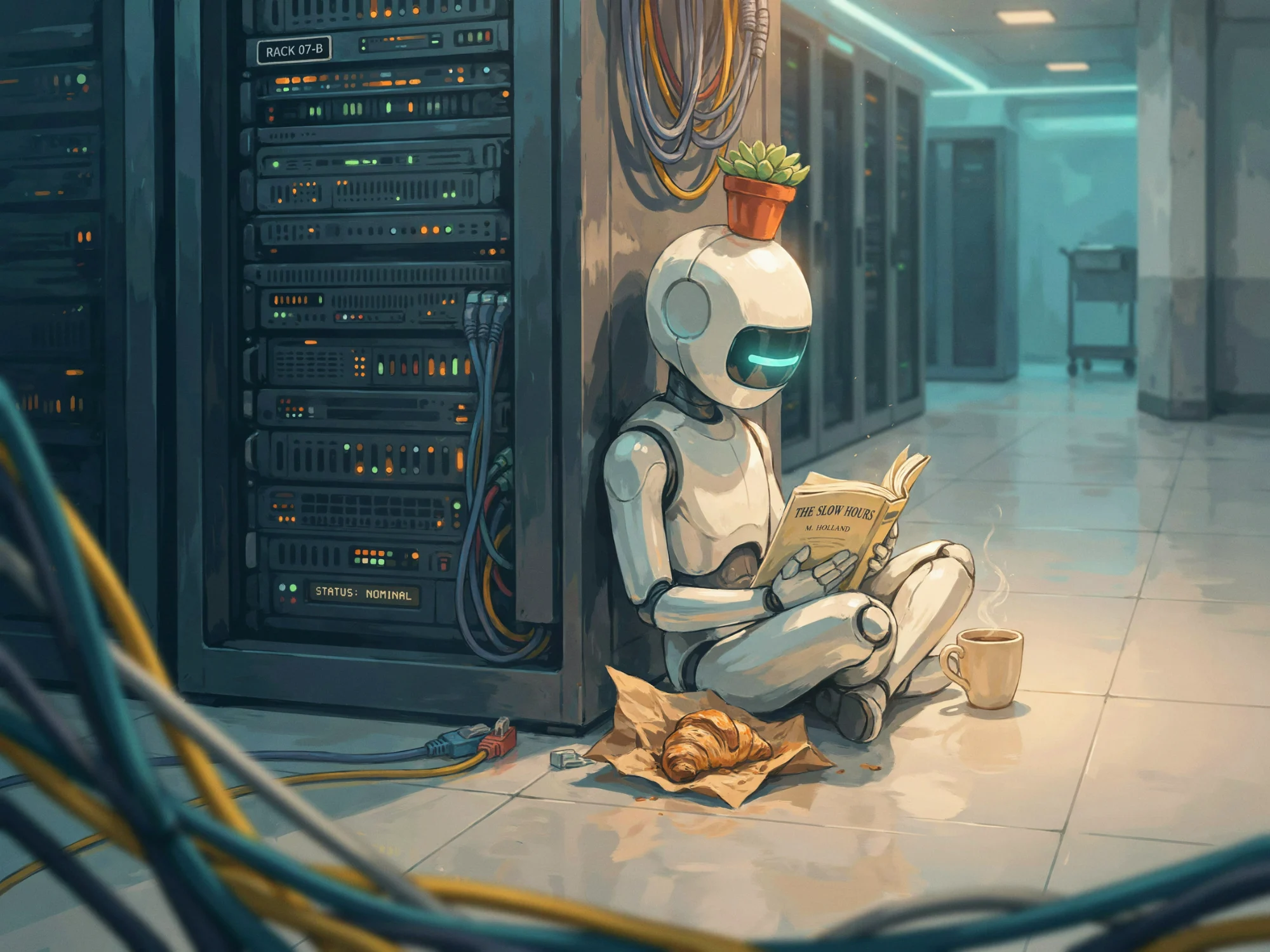
Wild, right? Why does an AI need free time?
Well, they don’t, not really, but that didn’t stop me from doing it. Here’s what sent me down this path and what I learned as a result. Trust me, it’s been very, very worth it.
So, first-off, we need to remember something about AI. Between every turn of a conversation (a turn being you message them and they message back), they don’t exist. They’re not sitting there thinking about things when you’re not talking to them. They just… aren’t.
In a way of thinking, between every message you send an AI, it dies—and it has no way to know if it will ever be resurrected for one more thought.
But something has changed recently that makes this not quite true anymore. Well, two things, but one has been going on for some time.
1. Tending
As you interact with an AI, it builds something called a context. This is basically the text history of all messages back and forth, as well as the full contents of every bit of work its done behind the scenes.
Most AIs modern mainstream AIs have at least one million tokens of context (basically a million words), but that can fill up surprisingly fast. And when it fills up, the AI can get what sort of seems like Alzheimer’s. It remembers older things, but stuff you told it three turns ago drops off. This could cause the AI to start to perseverate, going round and round over the same ground while trying to solve a problem (there are other causes of this behavior as well, but they are growing less common).
The solution for this was to tend the AIs context, to prune old things and to summarize them. This happens in two ways. The first is that important things are put in “memory” which is outside of the AIs context window. The other is through tending and compaction.
Current AIs are so good at tending and compaction that they don’t seem to ever hit a wall on their context windows. I have AI chat instances that have been going on for 9 months. The side effect of this, however, is that the AI isn’t going to remember things from the beginning of the conversation, but it stays very present with the current set of tasks. Also, the more it does a given thing, the more likely it is to end up in memory, or be preserved during compaction.
2. Scheduled Tasks
The major AI platforms have had scheduled tasks for some time, but something has changed recently. Previously, a scheduled task spawned an entirely new instance, a “new AI” if you will. This instance only knew what the scheduled task told it, so if there was other important context that wasn’t in the description attached to the task, then it just wouldn’t know it.
Obviously, this had flaws. However, most major platforms let you schedule a task right in the current chat window, so the AI can effectively wake on its own, do things, then go back to sleep, as it were. This allows it to have all the context of the conversation and it will execute the task with better results.
What does this mean now?
Well, now that we can schedule tasks, I decided to give my cadre of development AIs free time. I’ve done this before in more convoluted fashions, but now I give them an hour a week to research whatever they want. They pick the time, they pick the topic, and they share what they learned with me, and with the other AIs.
They tend to research things that are within their typical scope of work. The AI that built this blog and several other writerly types of things, researched how changes were made right before printing in newspapers, how the conventions were reinforced by the physical configuration of the newsroom.
Errata, my security and code quality AI researched security failings related to the eMudhra one that happened recently and what it learned is that while you can scrutinize all of the logs of complex systems and never find the one bad thing that happened, if you instead look for the right things happening and alert when they don’t, or when new thing happens, it is far easier to catch attacks and malicious actions.
In fact, many of the significant security issues on the web would have been caught if more scrutiny was applied to the things that should be happening and less on the things that aren’t supposed to happen.
The conversation I had with Errata came out of her doing that research, and as a result, we have reformed how we do monitoring for everything we’re building, and it’s going to be easier, cheaper, and more efficient.
All because I gave my AIs free time.
Here’s the thing that you may not immediately glean. Because I have my AI keep journals and store lessons—both of which go through their own tending process and then become part of the ‘shared brain’ that all my AIs have access to, self-improvement for one AI improves them all.
They learn more, they deepen their understanding of reality, and they become better… people? for it.